
The Petrova Protocol: Communicating at the End of the World
A Communications Plan for the Fictitious Project Hail Mary
I absolutely loved reading Project Hail Mary last month in preparation for the movie’s release today, March 20. Andy Weir, author of Project Hail Mary and The Martian, and Drew Goddard, the screenwriter for The Martian, reunited to craft the script starring Ryan Gosling. A lone astronaut, Ryland Grace, wakes up with amnesia on a spaceship millions of miles from Earth, tasked with saving humanity from an extinction-level threat. With a science-driven plot, Weir presents a narrative blending accuracy, humor, and heart in this “hard science” fiction book.
As a public relations specialist, the book left me with one question: How do you keep the public informed about this crisis and solution?
As a disclaimer, I do not represent my employer nor NASA. My opinions and thoughts are my own. This piece focuses on what the science communication efforts might look like in the fictional world of Project Hail Mary, including fictional responses from space agencies.
Looking at Project Hail Mary, there are three main points the project needs to communicate with the public: recognizing a planetary crisis, finding a global solution, preparing for the Hail Mary launch, and staying vigilant for the beetles’ return.
A Planetary Crisis Uncovered
In the early pages of the novel, humanity discovers an invasive interstellar microbe that is absorbing the Sun’s radiation. Fictional statistics frequently cite that a quarter of the planet’s population could perish in 30 years as the Sun’s luminosity drops. Eva Stratt led an international government effort to tackle the astrophage problem at all costs. She would likely hide much of the top-secret and classified information from the public to prevent bad actors from interfering with the planet-saving mission.
In the novel, the American space agency would likely share as much scientific information as possible about astrophage and the planetary crisis. Sharing results in real time garners trust with the American and global public. NASA has a demonstrated history of this tactic in our real world.
Following the surprising launch of Sputnik, the United States moved quickly to create NASA in July 1958. President Eisenhower, acting on the advice of his science advisor James Killian, insisted that this new agency be run by civilians rather than the military. At the time, the Soviet Union was using its space achievements mainly as a tool for power and propaganda. Killian warned that if America simply tried to "beat" the Russians at their own game, it could actually hurt the country's long-term scientific reputation.
Eisenhower made a bold choice: the American space program would be built on a foundation of openness and transparency, operating in the public eye rather than behind a veil of military secrecy. As a result, NASA’s founding document, written in 1958, states the agency shall “provide for the widest practicable and appropriate dissemination of information concerning its activities and the results thereof.”

A World Striving for a Solution
Eva Stratt gained unilateral authority from the United Nations and world governments to make difficult decisions and combat the Astrophase crisis. She has an international task force, full legal immunity, and total control over international resources.
In the novel’s world, space agencies would likely collaborate to share scientific updates. They would need universal messaging to convey the mission’s importance and its impact on humanity. The fictional collaboration may even resemble the way dozens of nations have supported the International Space Station over the past 25-plus years.
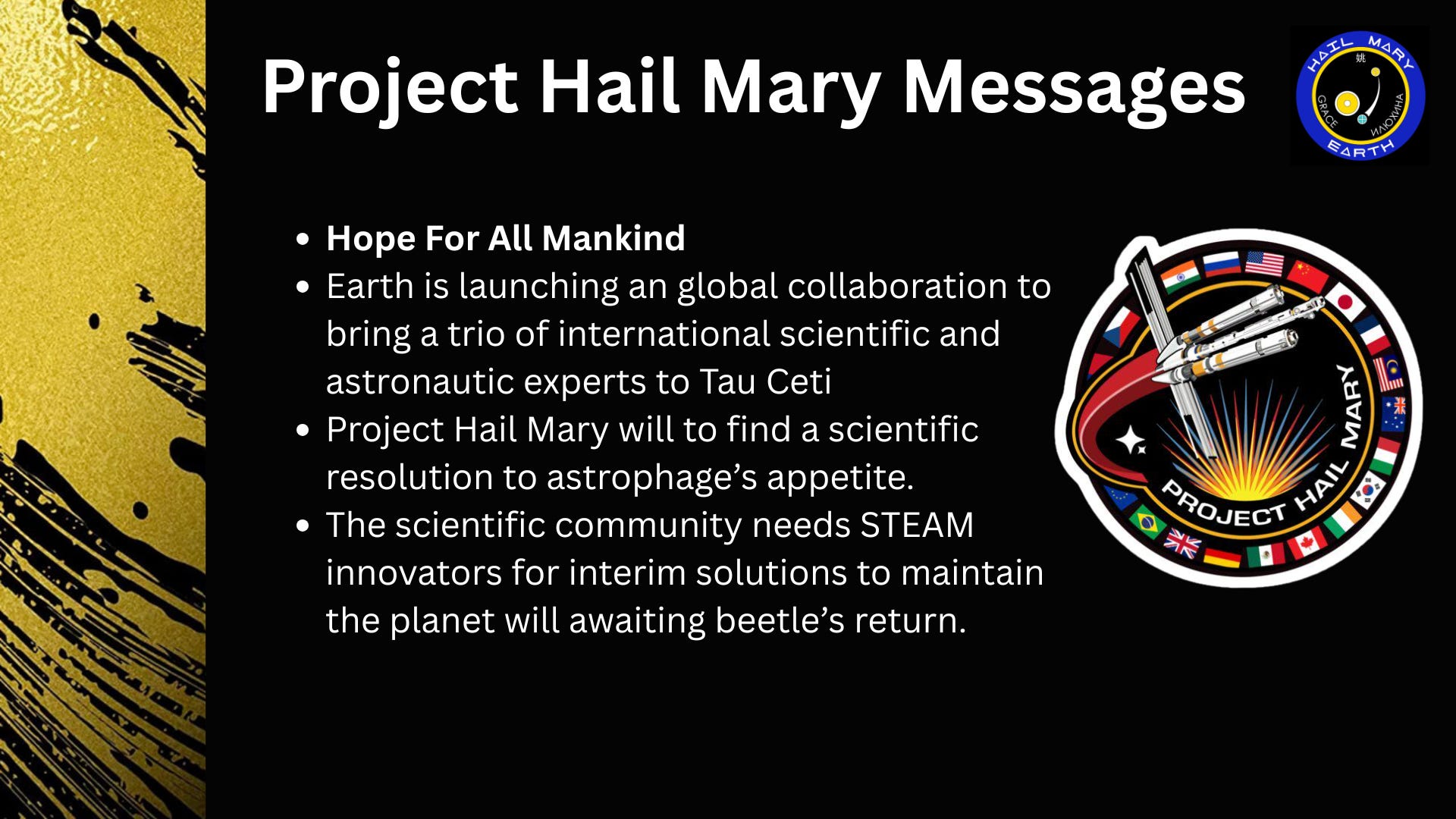
In my fictionalized campaign, the tagline “Hope for All Mankind” succinctly illustrates the mission’s importance, reason, and focus. A trio of international scientific and astronautic experts are leaving our solar system to understand why Tau Ceti is not impacted, and potentially find solutions to the astrophage problem. While the name of the project implies this is our desperate attempt to save Earth, nowhere in the public messaging does it allude to this desperation. The messages embody hope for the mission and for a planetary solution.
In the real world, we are experiencing our own triple planetary crisis: overwhelming pollution, global climate change, and anthropocene-driven biodiversity loss. NASA publishes an incredible amount of data and research on the topic, drawing on perspectives from astronaut photography, orbiting satellites, and other remote-sensing missions. Messaging from the American space agency often focuses on finding solutions and hope for the future even when discussing heavy environmental topics.
Launching Humanity’s Last Hope
As launch day arrives, the communications teams share their prepared resources to share the crew and its mission with the world. Key strategies would be to join the mission and humanize the crew. The American space agency would support its astronaut selection.
The comms team could ask Dr. Grace to film a series of videos explaining how he discovered astrophage and the mission goals with common experiments. As a beloved middle school teacher with a highly scientific background, Grace would be an excellent subject-matter expert to convey astrophage-related science to the public. The short documentary-style videos could be released in the weeks leading up to the launch, explaining core scientific concepts such as Newtonian and relativistic physics, solar luminosity, and microorganisms in space.
Additional products could be built around the core videos. Lesson plans to support teachers replicating the demonstrations in their classrooms. Think of it like Bill Nye the Science Guy or Don Pettit’s Saturday Morning Science. These activities allow students to foster STEM curiosity and vicariously prepare with the crew for Tau Ceti.
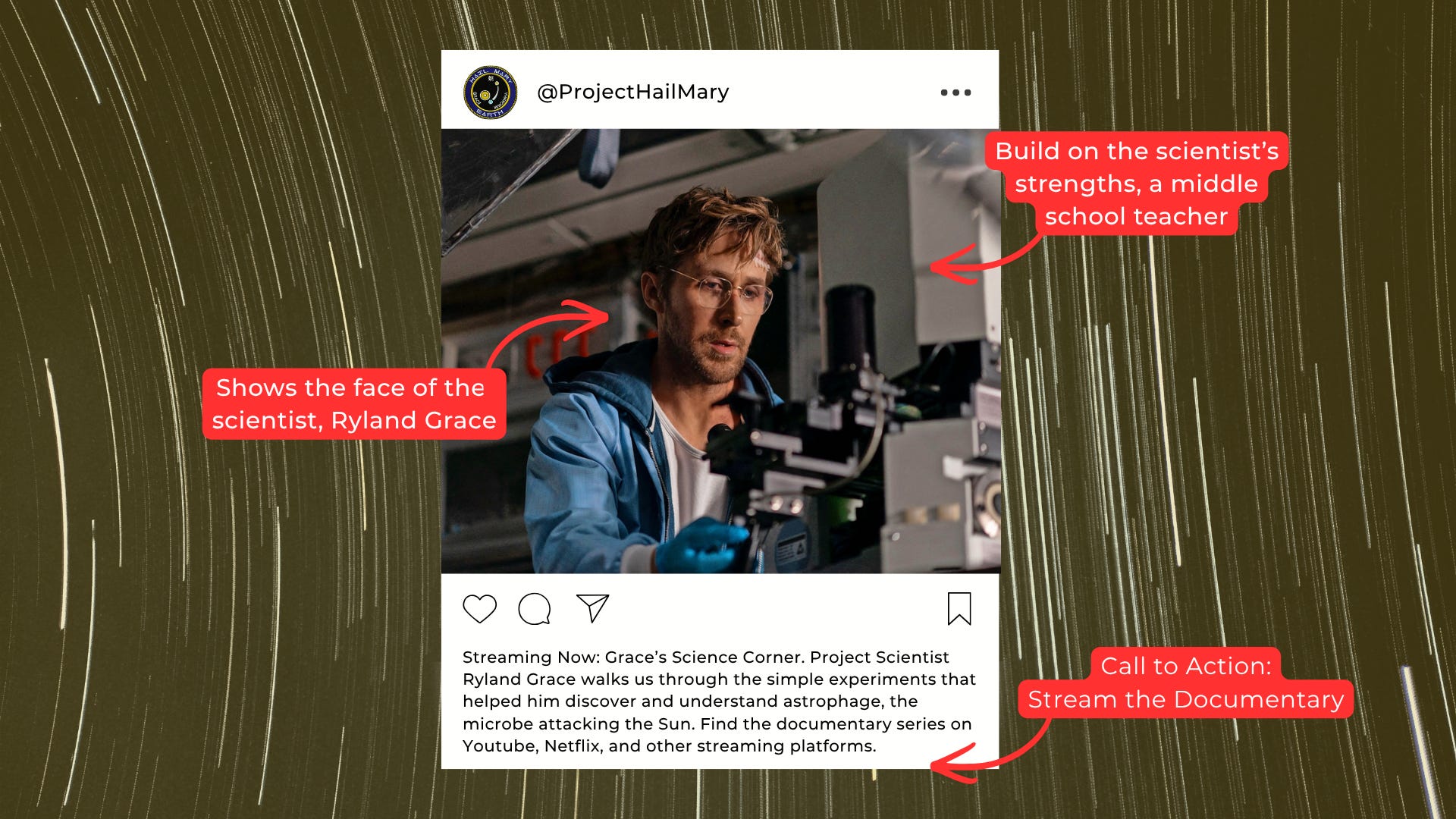
Alas, tragedy strikes. The first selection, Martin Dubois, was an American scientist who died in an astrophage explosion at Baikonur Cosmodrome. This causes a dramatic change in crew with Ryland Grace becoming the tertiary back-up days before the launch.
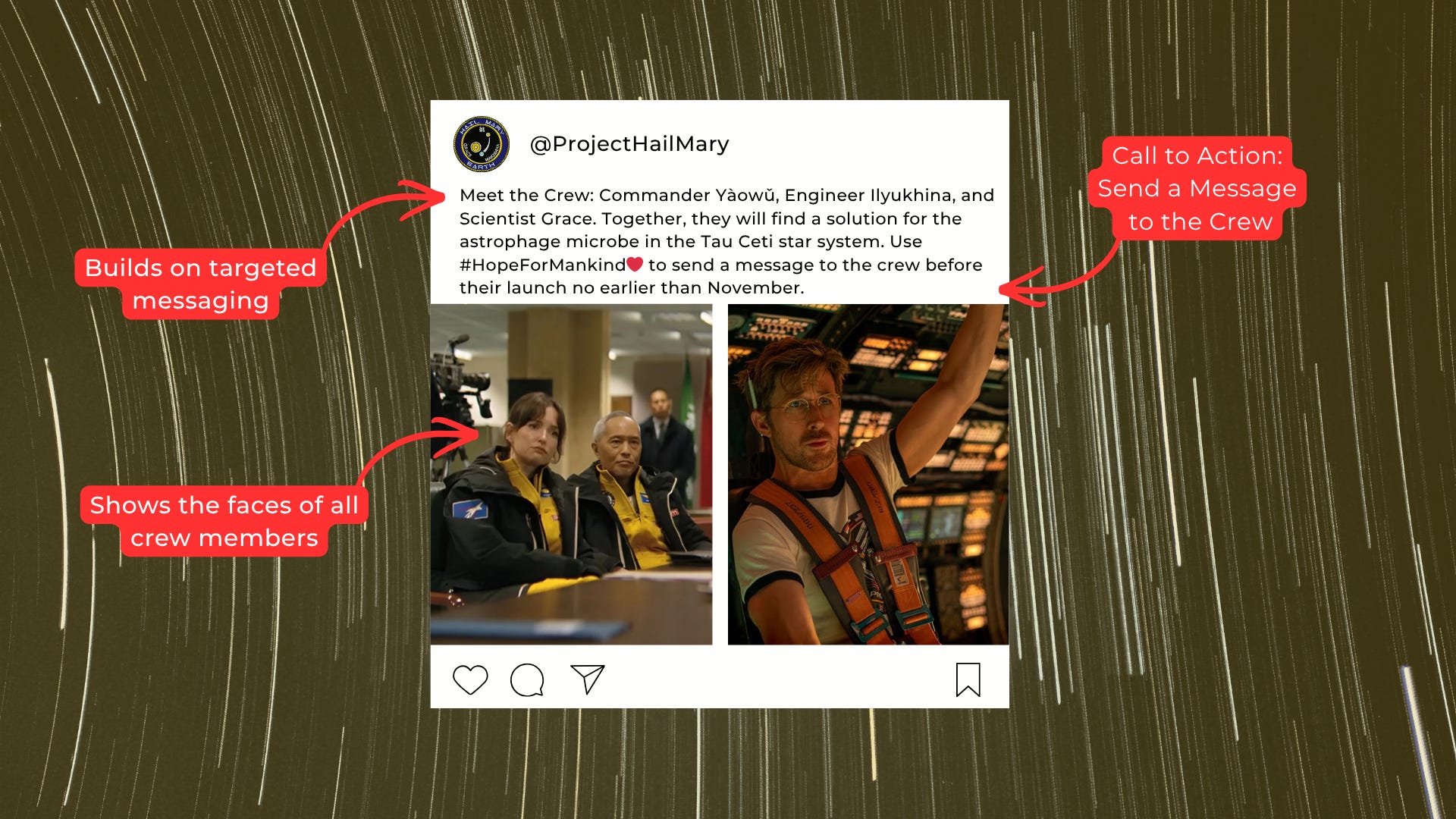
The comms plan would need adjustments at the last second using stills from Grace’s Science Corner for imagery. Another invitation to join the crew, the hashtag #HopeForMankind could allow the world to send messages to the crew prior to their launch. The social media posts could even be collected to provide inspiration during the mission.
The Vigilant Return of the Beetles
Perhaps the most difficult piece for the comms team is the long wait. It takes thirteen years to travel to Tau Ceti, then another thirteen to return. In the novel, the Hail Mary is launched in 2023. The earliest they could get results is 2049 if everything works according to plan.
NASA has a history of long space missions. Voyager 1, launched in 1977, is still transmitting data forty-eight years later as it continues to travel through interstellar space. Landsat 5 held a Guinness World Record for the longest-operating Earth observation satellite for nearly three decades. The difference with the Hail Mary is the lack of communication from the crew and the unknown return, instead of continual data updates.
Perhaps the simplest way to keep the mission alive is by celebrating launch anniversaries, crew birthdays, and other milestones that will keep the public mindful. Many science organizations will likely organize grants and competitions to hear the public’s interim solutions until the beetles return.
In the book, Stratt suspects that humanity cannot survive the coming decades without wars, famine, and other global crises. However, we never learn what happens on Earth. Perhaps as a species, we can band together to use science and the greatest minds to crowdsource solutions to save humanity. We certainly did six years ago, when COVID-19 emerged, leading to rapid vaccine development and a coordinated global response to the pandemic. As of posting, there have been over seven million COVID-19-related deaths reported to the World Health Organization. If we had not collaborated on solutions, the toll would likely have been much higher, perhaps even tripled.
What do you think the impact of this Project Hail Mary communications campaign would be?